RHEL 9 end of life: dates and what to upgrade to
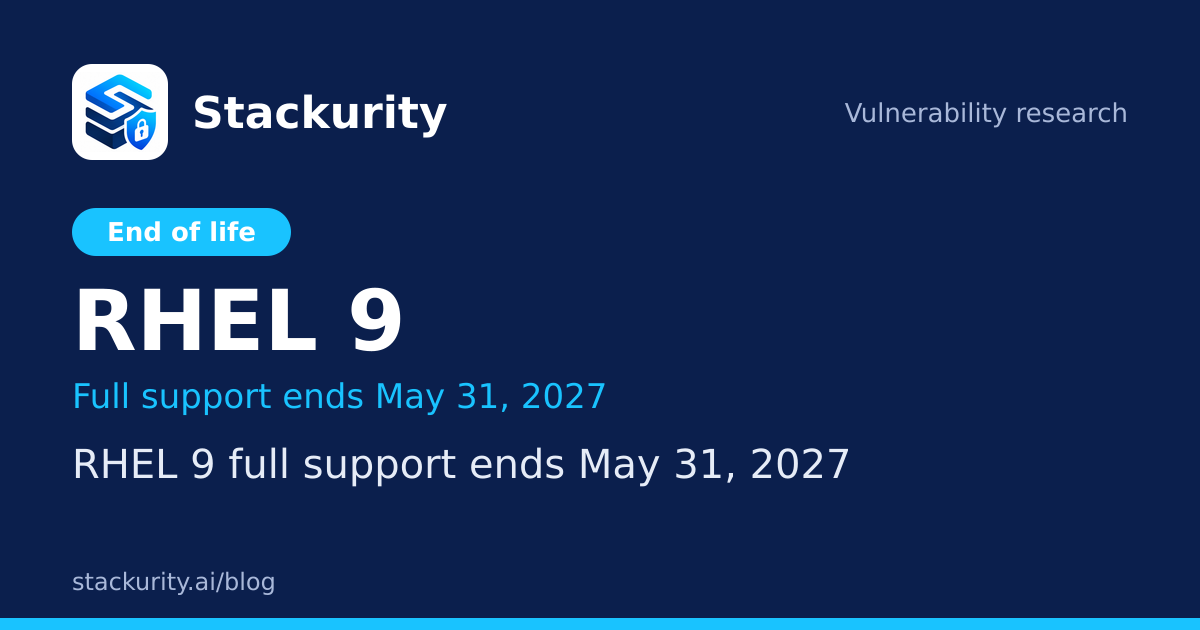
RHEL 9 full support ends May 31, 2027 and maintenance support May 31, 2032. See every date, what it means and what to upgrade to.

TL;DR
- RHEL 9 does not end all at once. Full support ends on May 31, 2027, maintenance support ends on May 31, 2032, and the paid Extended Life Cycle Support add-on runs to May 31, 2036.
- Red Hat Enterprise Linux 9 was generally available on May 18, 2022.
- After full support ends, Red Hat keeps shipping security fixes in the maintenance phase, but the set of changes narrows. After maintenance support ends, only the paid add-on remains.
- The release to move to is Red Hat Enterprise Linux 10: generally available on May 20, 2025, full support to May 31, 2030, maintenance support to May 31, 2035.
- Stackurity matches end-of-life data against your inventory every day and assesses Red Hat Enterprise Linux packages for vulnerabilities.
What reaches end of life and when
Red Hat defines several phases for each major release in its life cycle policy, and the endoflife.date page for Red Hat Enterprise Linux shows the same dates. For RHEL 9 they are:
- General availability: May 18, 2022.
- Full support ends: May 31, 2027. Until then the release gets the broadest stream of updates.
- Maintenance support ends: May 31, 2032. This is the date endoflife.date lists as the end of life for the release.
- Extended Life Cycle Support add-on ends: May 31, 2036. It is an add-on you buy, not part of a standard subscription.
Nothing has ended yet, and nothing stops working on any of these dates. The phases decide what kind of fixes Red Hat commits to deliver. In full support, Red Hat ships security fixes along with bug fixes and selected enhancements. In maintenance support, the commitment narrows to the most important fixes. After that, the paid add-on is the only supported route. The vendor's table also shows the extended phase as ongoing, which is a statement about the product line, not a date for this release.
What end of life means
The practical consequences arrive in order. When maintenance support ends, new vulnerabilities in the operating system no longer get a vendor fix unless you pay for the add-on. Auditors then ask for an exception, with an owner and a date, for every system on a release without standard support. Application vendors move on as well: they test newer releases and stop certifying older ones, so your own software can end its support for RHEL 9 before Red Hat does.
The earlier date matters too. After full support ends on May 31, 2027, the vendor only promises the most important fixes. Many teams treat that date as the point where the migration should already be underway, because moving a whole fleet takes longer than the calendar suggests. We covered the earlier major release in our guide to its end of life, and the pattern is the same.
What to upgrade to
The supported release to plan for is Red Hat Enterprise Linux 10. Red Hat's table and endoflife.date agree on its dates:
- Red Hat Enterprise Linux 10: generally available on May 20, 2025; full support ends May 31, 2030; maintenance support ends May 31, 2035; the Extended Life Cycle Support add-on runs to May 31, 2039.
Moving between major releases is a project, not a patch. Check Red Hat's documentation to see whether an in-place upgrade is supported for your setup, and rebuild on the new release where it is not. A typical plan:
- List every machine and image on RHEL 9, with the owner, the workload and the hosted applications. Include build agents and appliances that embed the operating system.
- Check each application vendor's support matrix for Red Hat Enterprise Linux 10, and test the workloads on it in a staging environment.
- Choose the order: internet-facing and compliance-scoped systems first, then internal ones, then rarely changed systems. Schedule each wave well before full support ends on May 31, 2027.
- Migrate wave by wave, keep the old machines for a quick rollback, and decommission them once the new ones are verified.
How to check one server by hand
To see which release a machine runs:
cat /etc/redhat-release
cat /etc/os-release
hostnamectl
The first line of /etc/redhat-release names the release and its minor version. To see the exact installed release package:
rpm -q redhat-releaseFor container images, read the base image named in each Dockerfile, and run the same commands inside a running container. A container always shows the release of its own image, not the host's.
How Stackurity flags it
Stackurity matches end-of-life data against your inventory every day, so a server on a release with a coming end date appears in the same list as its vulnerabilities, with the date. Packages on Red Hat Enterprise Linux are assessed too, using each ecosystem's own version rules so that distribution backports are not reported as false alarms. After you migrate a machine, Stackurity checks again and records whether the issue is really gone. The remediation guide explains how the list is ordered and verified.
FAQ
When does RHEL 9 reach end of life?
Maintenance support, which endoflife.date lists as the end of life, ends on May 31, 2032. Full support ends earlier, on May 31, 2027, and the paid Extended Life Cycle Support add-on runs to May 31, 2036.
Is RHEL 9 still getting security updates?
Yes. It is in full support until May 31, 2027, then in maintenance support until May 31, 2032.
What should I upgrade RHEL 9 to?
Red Hat Enterprise Linux 10, which has full support until May 31, 2030 and maintenance support until May 31, 2035.
When was RHEL 9 released?
Red Hat Enterprise Linux 9 became generally available on May 18, 2022.
What is the Extended Life Cycle Support add-on?
It is a paid add-on that extends support past maintenance support. For RHEL 9 it runs to May 31, 2036.
Does Stackurity flag RHEL 9 end of life?
Yes. It matches end-of-life data against your inventory every day, and it also assesses Red Hat Enterprise Linux packages for vulnerabilities.
Sources
Red Hat Enterprise Linux life cycle, endoflife.date, Stackurity product facts.