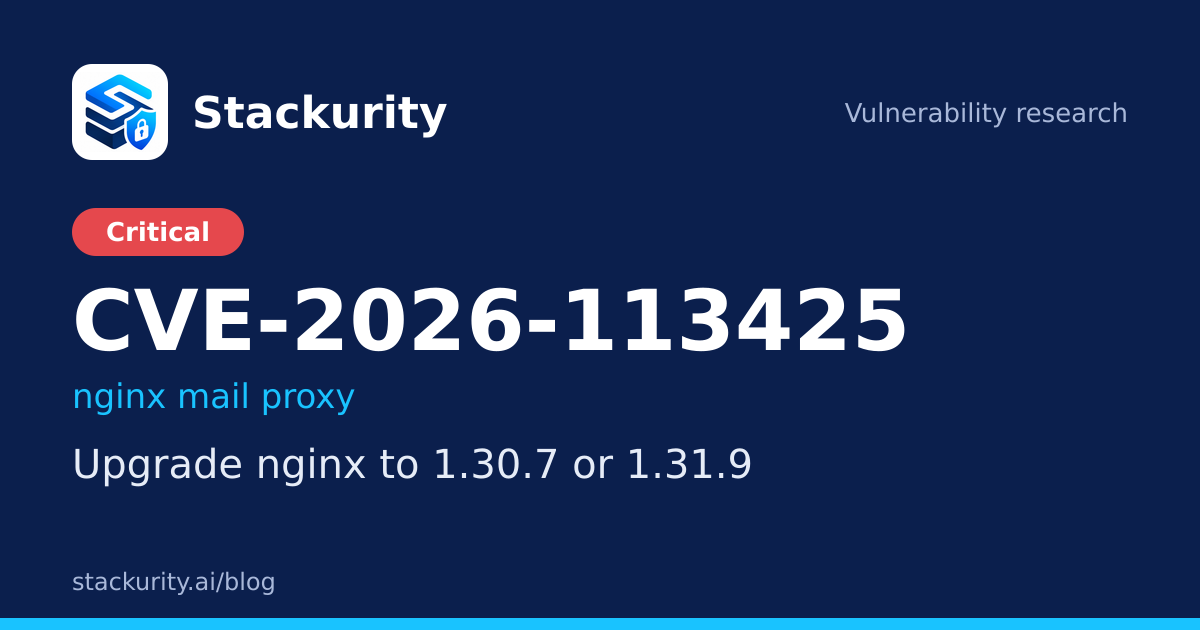
nginx CVE-2026-113425: mail proxy use-after-free, fix in 1.30.7 and 1.31.9
CVE-2026-113425 lets a remote attacker crash or corrupt an nginx mail proxy worker. Check your config and upgrade to 1.30.7 or 1.31.9.

TL;DR
- What: CVE-2026-113425 is a memory-reuse bug (use-after-free) that nginx's mail proxy can hit inside a worker.
- Impact: a remote, unauthenticated attacker may crash a worker or corrupt its memory. Code execution is possible where ASLR is off or can be bypassed.
- Severity: a CVSS v4.0 score of 9.2 and a CVSS v3.1 score of 8.1 from F5.
- Exploited: not listed as exploited in the CISA catalogue at the time of writing.
- Fix: upgrade NGINX Open Source to 1.30.7 or 1.31.9, or NGINX Plus to a release past the affected range.
What the vulnerability is
A use-after-free means a program keeps using a piece of memory after it has handed it back. When an attacker can steer what ends up in that memory, the result can be a crash, corrupted data or, in the worst case, running the attacker's code. The weakness class is CWE-416.
In CVE-2026-113425, the trigger sits in nginx's mail proxy feature. According to the National Vulnerability Database record, undisclosed traffic sent to an nginx instance configured as a mail proxy can cause the bug in a worker process. F5 describes the impact as a worker crash or memory corruption that disrupts service, with remote code execution as a potential result. It is a data plane issue only: the control plane is not exposed.
Two details matter for planning. First, no authentication is needed: the attacker only has to reach the mail proxy port. Second, the code execution path depends on address space layout randomization (ASLR) being disabled or bypassed. Most modern Linux servers keep ASLR on, which raises the bar, but a crash that restarts workers repeatedly is still an outage.
Why it matters now
The record was published on November 18, 2026 and later modified. Memory corruption flaws in a network daemon are the kind that attackers study closely once a fix is public, because comparing the old and new source points to the bug. If you run nginx as a mail proxy in front of an internal mail system, that port is usually open to the internet by design.
Most nginx deployments are not mail proxies, so many teams will correctly find that they are not exposed. The risk is the machine nobody remembers: an old gateway, a container image with a custom config, a mail relay set up years ago. That is why the question is not only "are we patched" but "where do we run nginx with a mail block at all".
We covered the wider batch of nginx flaws in our post on the nginx2root bugs. This post is the narrower question for one CVE: which servers actually proxy mail. If you track Linux and web server fixes across many machines, our note on tracking this without a heavyweight scanner shows how a small team can do it.
Am I affected?
The NVD record lists these NGINX Open Source ranges as affected: from 0.5.33 up to 1.30.7 (excluding), and from 1.31.0 up to 1.31.9 (excluding). So the stable line is fixed in 1.30.7 and the mainline in 1.31.9. For NGINX Plus the record lists from 37.0.0 up to 37.0.8 (excluding), from 37.1.0 up to 37.3.0 (excluding), and the older releases r34, r35 and r36. It also lists F5 products that bundle nginx, such as the ingress controller, gateway fabric, instance manager and WAF, each with its own range in the record.
The affected version alone is not enough. The flaw is in the mail proxy, so check both the version and the configuration on one machine:
- Show the version and the build options:
nginx -V. A mail proxy needs the mail module compiled in, and the build flags list it. - Dump the full effective configuration and look for a mail block:
nginx -T. If there is no mail block, the mail proxy is not in use. - On Debian and Ubuntu, show the installed package:
dpkg -l nginx. - On Red Hat style systems, show it with
rpm -q nginx.
Remember the backport caveat. Debian, Ubuntu and Red Hat fix flaws inside the version they ship, so an installed package that shows an older upstream number may already contain the fix. Compare the package build against the distribution's security notice. Our post on Ubuntu's nginx security notice shows what that looks like in practice.
How to fix CVE-2026-113425
- List every machine and image that runs nginx, including source builds in
/usr/local/nginxand nginx compiled into container images. - For each, decide whether it uses a mail block. Those machines go first, because they are the exposed ones.
- Upgrade NGINX Open Source to 1.30.7 on the stable line or 1.31.9 on the mainline. On a distribution package, install the package update that the distribution's security notice names.
- For NGINX Plus, upgrade to a release past the ranges in the record, 37.0.8 or 37.3.0 or later, following the vendor advisory from F5.
- Test the configuration with
nginx -tand reload the service. Then confirm the running binary reports the fixed version withnginx -v. - If you cannot upgrade today, restrict who can reach the mail proxy ports to known mail servers and clients, and plan the upgrade for the next window.
The vendor advisory is the authority for the full list of fixed products: F5 article K000163931.
How to check with Stackurity
Stackurity keeps one live inventory of the software on your servers, container images and repositories, and matches it against new advisories every hour. For nginx, the agent reads the packages installed on Linux servers, and also matches source builds in /usr/local/nginx, the nginx compiled into container images and Homebrew's nginx by the release they report. The action plan then lists the upgrade, most urgent first, with every place it is needed.
Be clear about the limits. NGINX Plus, OpenResty, Tengine and Angie are not matched, and Stackurity says so rather than reporting them as clean. Check those by hand against the F5 advisory. Stackurity reads package versions, not your nginx configuration, so it cannot tell you whether a server uses a mail block: use the nginx -T check above for that.
After the upgrade, Stackurity checks again and records whether the issue is really gone. Read how the remediation workflow works, then start a free Stackurity trial to see which of your servers still run an affected nginx.
FAQ
Am I affected if I only use nginx as a web server or reverse proxy?
The description of CVE-2026-113425 limits the flaw to nginx configured as a mail proxy. If your configuration has no mail block, this specific bug is not in your path, but you should still upgrade to the fixed releases because other nginx flaws are fixed in the same versions.
Which nginx versions fix CVE-2026-113425?
For NGINX Open Source, upgrade to 1.30.7 on the stable line or 1.31.9 on the mainline. For NGINX Plus, the affected ranges end before 37.0.8 and 37.3.0, so move to those releases or later.
Is CVE-2026-113425 exploited in the wild?
It is not in the CISA Known Exploited Vulnerabilities catalogue at the time of writing. That can change, so treat the fix as urgent for any internet-facing mail proxy.
Do distribution packages have the fix under an older version number?
They can. Debian, Ubuntu and Red Hat backport fixes into the version they ship, so the upstream number on an installed package may look old while the flaw is gone. Check the distribution's security notice for the package build.
Does Stackurity cover NGINX Plus?
No. Stackurity matches nginx Open Source from packages, source builds and container images, but it does not match NGINX Plus, OpenResty, Tengine or Angie, and says so. Check those against the vendor advisory by hand.
Sources: NVD record for CVE-2026-113425, F5 advisory K000163931 and Stackurity product facts.